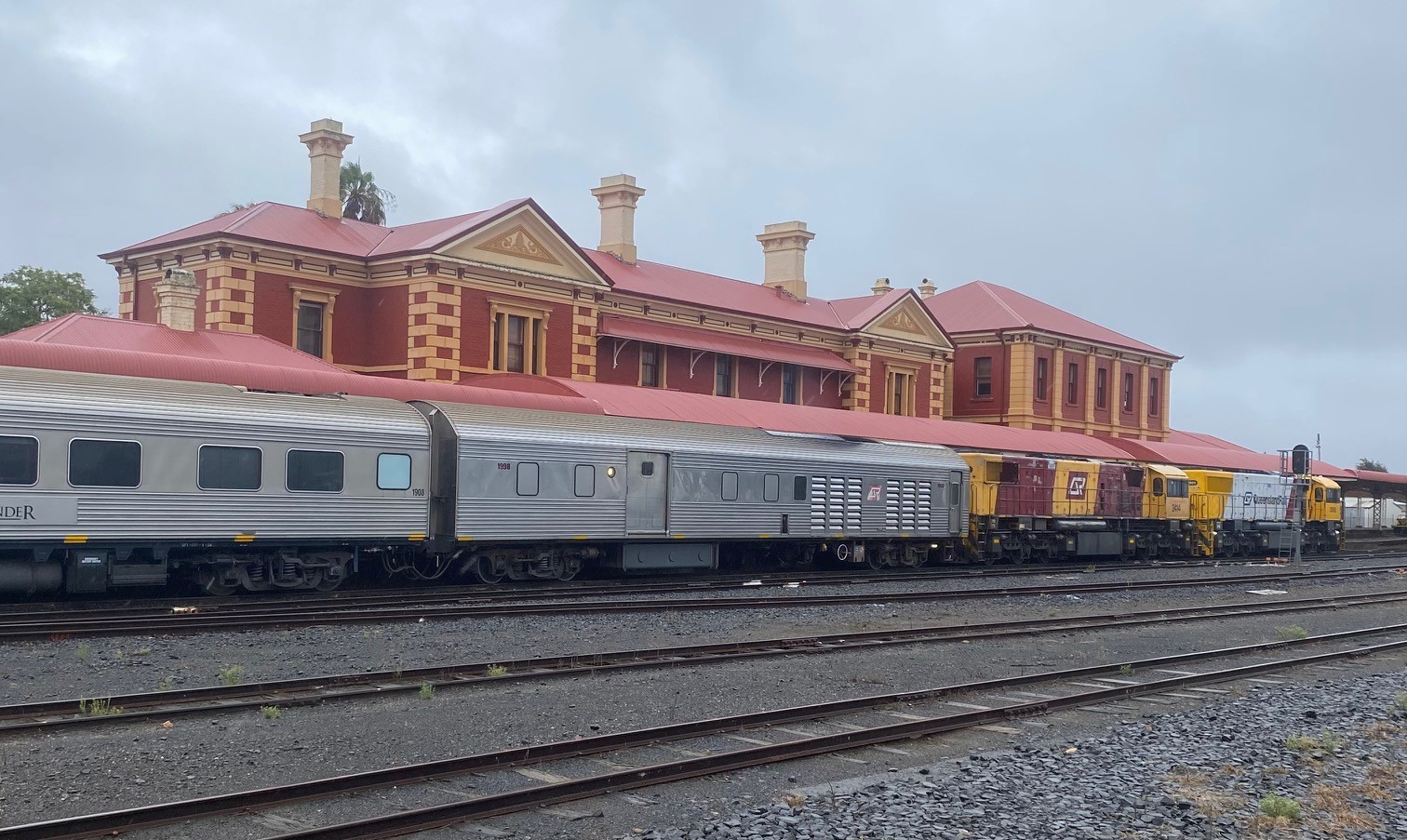

Walk through central Toowoomba today and it is almost impossible not to encounter the Marks family.
Their buildings are scattered through the city: churches and halls, grand houses and commercial premises, places associated with religion, business and everyday life. Some are immediately noticeable. Others are buildings we may pass without thinking about the people who designed them.
But taken together, they tell a remarkable story.
For more than half a century, James Marks and his sons Henry James, better known as Harry, and Reginald Marks helped shape the architectural identity of Toowoomba. The architectural practice established by the family became so important that it has been described as having dominated architecture in Toowoomba and the surrounding district for more than fifty years.
That makes the Marks story much more than a story about architects.
It is a story about the making of Toowoomba itself.
James Marks: the pioneer
The story begins with James Marks.
Born in England in 1834, Marks trained as a carpenter and developed skills in building construction, joinery and architectural drawing. He arrived in Queensland in 1866, initially establishing himself at Dalby before moving to Toowoomba in 1874.
Marks arrived during the formative decades of European settlement on the Darling Downs. Toowoomba was changing rapidly from a young colonial settlement into the commercial and administrative centre of the region. It is into this environment that Mark’s genius emerged to shape the formation of the city.
His obituary gives us a wonderful contemporary description of him. It remembered Marks as a man who had been associated with the development of the region for half a century and whose pioneering work as both builder and architect had contributed substantially to the prosperity later generations enjoyed.
Before establishing his architectural career in Toowoomba, Marks worked on properties throughout the Downs, constructing homesteads, woolsheds, wells, tanks and other infrastructure. His work therefore belonged to that first great period of pastoral and urban development on the Darling Downs.
When he turned increasingly to architecture, his commissions began appearing throughout Toowoomba. They included churches in Bell, Neil and James streets; commercial buildings; the Royal Bank; AMP offices; and work associated with the Bank of New South Wales.
Among the buildings associated with him are Weetwood, Redlands, St Patrick's Cathedral, St Matthew's Anglican Church at Drayton, Smithfield House and Vacy Hall. Several are now entered in the Queensland Heritage Register, including Weetwood, Redlands, St Patrick's Cathedral, St Matthew's and Smithfield House.
Collectively these buildings preserve a physical record of Toowoomba's transformation during the late nineteenth century.
Then came Harry
If James Marks helped establish the family's architectural reputation, his eldest son took it in a remarkable new direction.
Henry James "Harry" Marks was born in Toowoomba in 1871. After training under his father, he became his partner in 1892 and the practice became James Marks and Son. Reginald Marks would also work in the family firm.
While a master of the skills of architecture Harry was also an inventor. He patented ventilators, developed reversible casement windows and experimented with methods of stucco construction. He was recognised professionally as an Associate of the Queensland Institute of Architects in 1925 and became a Fellow in 1929.
His surviving works form an extraordinary architectural trail through the city: Gowrie House, the Alexandra Building, Rodway, the Exchange Building, Bishop's House, St James Parish Hall Glen Alpine, St Luke's Hall, Valetta and Karingal Chambers
The significance of Harry's contribution was recognised during his own lifetime. When he died suddenly in 1939, the Courier-Mail described him as one of the oldest architects on the Darling Downs and remarkably stated that he had been architect for “nearly all the principal business blocks in Toowoomba.”
Harry’s influence in designing the streetscape of Toowoomba is unmistakeable.
And there was Reginald
Reginald Marks can easily disappear beside his better documented father and brother, but this would distort the story.
James's obituary specifically says that his two sons, Harry and Reg, had effectively been conducting the architectural business themselves during the later years of their father's life and had done so “with marked success.”
Reginald therefore deserves to be understood as part of the continuity of the family practice rather than merely as Harry's younger brother.
The White Horse Hotel one of Toowoomba’s most distinguishable buildings, and the Taylor's Building, both dating from 1912, are among works associated with Reginald.
An architectural family unlike any other in Toowoomba
There is something remarkable about looking at the Marks buildings collectively. They weren't confined to a single architectural type.
The family's work included:
James, Harry and Reginald Marks didn't simply design buildings in Toowoomba. To an extraordinary degree, they helped design Toowoomba.
References:
03 May 1917 - HARRY J. MARKS, MARGARET-STREET, TOOWOOMBA. - Trove
02 Mar 1939 - Sudden Death of Downs Architect - Trove
30 Oct 1915 - DEATH OF MR. JAMES MARKS. - Trove
05 Sep 1913 - DEATH OF A TOOWOOMBA PIONEER. - Trove
Queensland Heritage Register https://www.qld.gov.au/environment/land/heritage/register